


Mein Anker
Would you like it similar or pretty?
A film by Renata Münzel
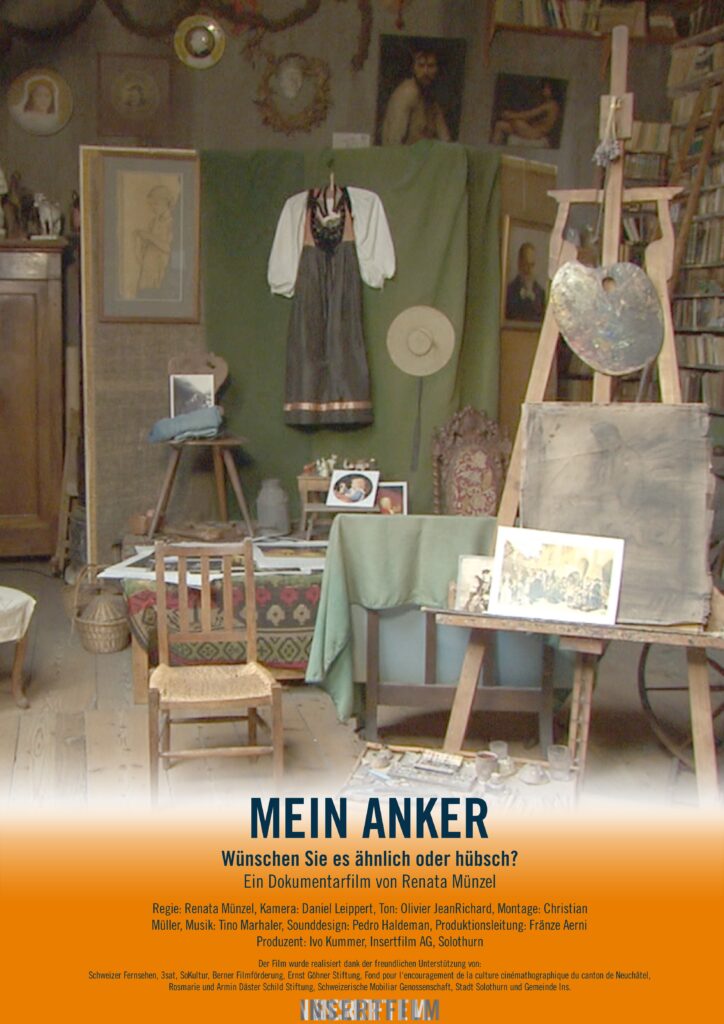
Documentary film, HD 16:9, 52 min, 2010
Director: Renata Münzel
camera: Daniel Leippert
Sound: Olivier JeanRichard
Edit: Christian Müller
Music: Tino Marhaler
Sounddesign: Pedro Haldemann
Producer: Ivo Kummer, Insertfilm AG
production management: Fränze Aerni
Albert Anker is an artist whos work is full of prejudices and ideological misunderstandings. It is worthwhile now to rediscover him. The history of the Ankers life and work is also a piece of Swiss history, in a rapidly renewing world of the 19th century. In the film, different people talking about their Albert Anker. From these personal opinions results the image of a extremly talented, but also cautious person, a cosmopolitan European, an artist who wanted to decently feed his family, and was always torn between paid and his proper creative work.

media dossier
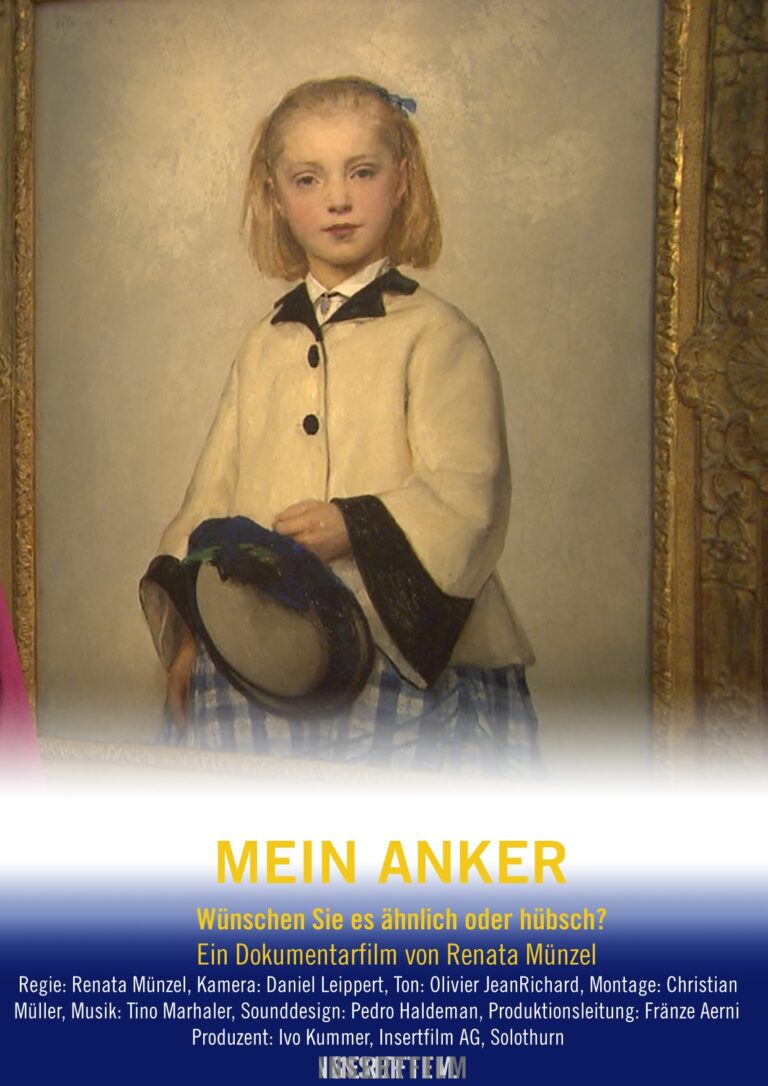
Kulturanzeiger 5.01
If Anker had painted Fixer
Following the exhibition, now comes the film: in Mein Anker (My Anchor), Aargau-based director Renata Münzel examines the life and work of the important Bernese artist in the 100th anniversary year of his death – and uncovers much that is already well known.
The surprise comes at the end: little-known travel sketches by Albert Anker are shown – watercolours depicting harbour scenes or distant cities. Otherwise, the documentary film ‘Mein Anker’ (My Anchor) by Aargau-based director Renata Münzel fails to shed any new light on the life and work of the artist from Ins. This is not least due to the huge media attention generated by the Anker retrospective at the Kunstmuseum Bern: there is not a single Anker expert, relative or curator who has not spoken about the great Swiss artist on television, radio or in newspapers in recent weeks. Thus, ‘Mein Anker’ repeats quotes from Anker’s great-great-grandson Matthias Brefin or the famous Anker collector Christoph Blocher, captured by cameraman Daniel Leippert in picturesque images.
Intimate insights
In interview sequences with cultural figures who talk about their personal favourite paintings in the museum space, the documentary stands out and conveys an intimate picture. In ‘Die Genesende’ (The Convalescent), dramaturge Katja Früh recalls her childhood desire to stay in bed as long as possible when she was ill so that she could stay away from school. And in ‘Die Turnstunde’ (The Gym Class), illustrator Hannes Binder recalls his own experiences of physical education classes. Unfortunately, these fascinating accounts are embedded in a rather neglected dramaturgy that begins with Anker’s birth in 1831 and ends with his death in 1910 – accompanied by comments from the director, whose rustic slowness overshadows every prevailing Anker cliché.
Unerwartete Filmmomente
In stark contrast to Renata Münzel’s comments are the interview sequences with Zurich art book publisher and cabaret artist Patrick Frey, who unceremoniously relocates Anker’s home village of Ins to the Bernese Oberland. He not only brings pace to the film, but also a reflective, intellectual view of Anker’s work. For example, he reflects on the Zurich drug scene and concludes that ‘Anker would probably have painted a child in the corner of a room, shooting up’. It is these brief, unexpected moments in the film that save ‘Mein Anker’ from arbitrariness.


